
When we think of hospice care, we naturally think of physical comfort, pain management, and emotional support. The core mission has always been to add life to days when days can no longer be added to life. But as the landscape of end-of-life care evolves, a surprising new tool is emerging to help fulfill that mission: Virtual Reality (VR).
Once thought of as just a gadget for gamers, VR is quickly becoming one of the most innovative, non-pharmacological interventions in palliative and hospice care today. 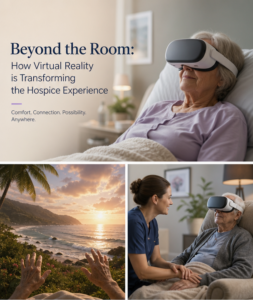
Breaking the Boundaries of the Bed
For many hospice patients, mobility is severely limited. The world shrinks to the size of a bedroom or a facility ward. VR technology changes this by allowing patients to put on a lightweight headset and instantly step outside their physical limitations.
Through carefully curated virtual experiences, patients can:
-
Fulfill “Bucket List” Dreams: Whether it is visiting the Eiffel Tower, sitting on a beach in Hawaii, or viewing the Northern Lights, VR allows patients to experience places they can no longer travel to physically.
-
Revisit Meaningful Memories: Some programs use Google Earth VR or custom recordings to let patients “walk” down their childhood street, visit their hometown, or see the church where they were married.
-
Immerse in Nature: High-definition nature walks, sitting by a peaceful stream, or watching a gentle snowfall can provide profound emotional grounding.
A New Frontier in Symptom Management
The benefits of VR in hospice go far beyond entertainment; the clinical outcomes are showing remarkable promise.
-
Pain Reduction: VR acts as a powerful distraction technique. By overwhelming the brain’s sensory pathways with positive, engaging stimuli, patients often report a significant temporary decrease in pain levels, reducing the immediate need for breakthrough medication.
-
Anxiety and Restlessness: Transitioning at the end of life often brings terminal restlessness or severe anxiety. Gentle, guided meditation VR experiences—featuring calming voices, soothing music, and tranquil visuals—have been shown to lower heart rates and ease breathing.
-
Combating Isolation: Experiencing something new and awe-inspiring gives patients something exciting to talk about with their families and caregivers, shifting the conversation away from illness and toward joy.
The Human Connection
Technology in healthcare can sometimes feel cold or clinical, but in this context, it acts as a bridge to deep human connection. Caregivers and family members can often see what the patient is seeing on an external tablet, allowing them to share the journey. It creates a space for joy, tears, and beautiful shared memories in a time that is often defined by grief.
Looking Ahead
As VR headsets become more affordable, lighter, and easier to sanitize, we can expect to see them become a standard tool in the hospice “comfort kit”—right alongside favorite blankets, music therapy, and PRN medications.
By embracing these thoughtful technological advancements, hospice professionals can continue to do what they do best: provide profound, whole-person care that honors the dignity and spirit of every patient.
Would you like me to adjust this to focus more on the administrative or technological side of hospice (like predictive analytics for care coordination), or does this patient-focused VR angle hit the mark?
References & Further Reading
-
Nwosu, A. C., Mills, M., Roughneen, S., et al. (2021). Virtual reality in palliative care: A systematic review. Palliative Medicine, 35(6), 1065–1077. This comprehensive review explores how VR is actively being used across various palliative care settings to manage pain, anxiety, and depression.
-
Niki, K., Matsumoto, H., Machizawa, S., et al. (2019). A novel palliative care approach using virtual reality for improving various symptoms of terminal cancer patients: A preliminary study. Journal of Palliative Medicine, 22(6), 702–707. This study demonstrates the physiological and psychological benefits of VR, specifically noting improvements in fatigue, pain, and anxiety among terminal patients.
-
Spiegel, B. (2020). VRx: How Virtual Therapeutics Will Revolutionize Medicine. Basic Books. Written by a leading researcher in clinical virtual reality, this book provides excellent background on how VR is shifting from entertainment to a legitimate medical intervention for pain and end-of-life care.
-
Brungardt, A., Wibben, A., et al. (2021). Virtual Reality in the Inpatient Setting: Patient Experiences and Impacts on Pain and Anxiety. Journal of Palliative Medicine, 24(5), 736–740. This paper details firsthand patient experiences with VR in a palliative setting, highlighting its effectiveness as a non-pharmacological distraction therapy.
OPENING HOURS
| Week Days | 9:00 – 15:00 |
| Saturday | Office Closed |
| Sunday | Office Closed |