
Hospice is one of the most meaningful services available to patients facing terminal illness, but many patients and families receive it too late to experience its full benefit. In Medicare, hospice is designed for patients whose physician certifies a life expectancy of six months or less if the disease follows its usual course, and the focus changes from cure-directed treatment to comfort, symptom relief, dignity, and family support. The Medicare hospice benefit includes nursing care, physician and nurse practitioner services, medical equipment, supplies, medications for pain and symptom control, hospice aide services, social work, dietary counseling, spiritual counseling, grief counseling before and after death, respite care, and short-term inpatient care when symptoms cannot be managed at home.
Despite the breadth of the hospice benefit, many patients enter hospice only in the final days or weeks of life. The 2025 Facts and Figures report from the National Alliance for Care at Home found that the average hospice length of stay for Medicare decedents in 2024 was 88.6 days, but the median stay was only 21 days, meaning half of Medicare hospice decedents received three weeks or less of care. MedPAC’s 2026 report similarly found that, among Medicare decedents, the median lifetime hospice length of stay was only 19 days in 2024, even though hospice eligibility can begin much earlier when the terminal prognosis is present. This short median stay shows a central problem: hospice is often treated as “last days care” rather than a comprehensive end-of-life service meant to support patients and families over time.
Early enrollment matters because hospice care is not a single visit, a medication kit, or a crisis response. It is an interdisciplinary plan of care that requires assessment, relationship-building, medication adjustment, caregiver teaching, spiritual and emotional support, and practical preparation. A hospice nurse may need time to evaluate pain, dyspnea, anxiety, wounds, nutrition, swallowing, bowel patterns, fall risk, and medication burden. The social worker may need time to assess caregiving needs, financial stress, family conflict, advance directives, funeral planning, and community resources. The chaplain may need time to address fear, grief, forgiveness, meaning, and spiritual distress. The hospice aide may gradually become essential as weakness and dependence increase. These benefits cannot be fully delivered when hospice begins only hours or days before death.
Early hospice also gives patients the opportunity to define what comfort and dignity mean to them. Many terminally ill patients experience repeated hospitalizations, emergency room visits, intensive care stays, burdensome testing, and treatments that may no longer match their goals. Hospice creates space for a different question: “What matters most now?” For one patient, the answer may be staying at home; for another, it may be pain relief, reconciliation with family, spiritual peace, or avoiding another hospitalization. Research supports this shift. Kelley and colleagues found that Medicare hospice enrollment was associated with lower hospital service use, fewer ICU admissions, fewer hospital days, fewer readmissions, and lower rates of in-hospital death compared with matched non-hospice controls. The same study found Medicare savings across several enrollment windows, including 1–7, 8–14, 15–30, and 53–105 days before death, suggesting that timely hospice can improve care patterns while reducing unwanted high-intensity utilization.
The timing of hospice is especially important for symptom control. Terminal illness often brings escalating pain, shortness of breath, agitation, delirium, nausea, constipation, secretions, anxiety, insomnia, wounds, weakness, anorexia, and caregiver exhaustion. When hospice begins early, the team can anticipate these symptoms instead of reacting after a crisis has already developed. Medications can be adjusted carefully, durable medical equipment can be delivered before falls or transfers become unsafe, and caregivers can be taught what symptoms are expected, what medications to give, when to call hospice, and when a change is part of the natural dying process. CMS recognizes four levels of hospice care—routine home care, continuous home care during a brief crisis at home, inpatient respite care for caregiver relief, and general inpatient care for symptoms that cannot be managed in another setting. Early enrollment gives the hospice team time to use the right level of care at the right time.
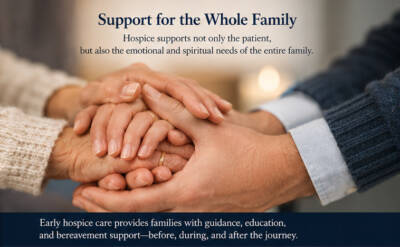
Early hospice also benefits families. Families often carry the physical and emotional burden of end-of-life care, and many are unprepared for what dying looks like. Late hospice enrollment can leave families frightened, exhausted, and unsure whether they did the right thing. Earlier involvement allows hospice staff to teach families how to turn and reposition the patient, administer comfort medications, manage oxygen, recognize terminal decline, and understand changes in appetite, breathing, consciousness, and urine output. It also allows time for anticipatory grief support before the death occurs. Hospice is unique because it treats the patient and family as the unit of care, and CMS specifically includes grief and loss counseling before and after the patient’s death as part of hospice-covered services.
The evidence from palliative care research reinforces the importance of earlier supportive care. In a landmark randomized trial among patients with metastatic non-small-cell lung cancer, early palliative care improved quality of life and mood, reduced aggressive end-of-life care, and was associated with longer survival compared with standard oncology care alone. While palliative care and hospice are not identical—palliative care can occur alongside curative treatment, while hospice is for terminal illness when comfort-focused goals are elected—the lesson is highly relevant: patients benefit when comfort, communication, symptom management, and family support begin earlier rather than later. Caregiver research also shows that early integrated palliative care can improve caregiver outcomes, including mood and coping, which matters because caregiver distress directly affects the patient’s home experience.
Late enrollment remains common and harmful. A retrospective study of more than 64,000 patients with cancer found that approximately one in six were admitted to hospice within the final three days of life. This pattern leaves little time to stabilize symptoms, establish trust, complete meaningful life closure, provide caregiver education, arrange equipment, or prevent a final unwanted hospital transfer. It also places the hospice team in a reactive position, often trying to accomplish in one night what ideally should have started weeks earlier. StatPearls summarizes the practical issue clearly: longer hospice lengths of stay are generally more beneficial to patients and families, though the quality of care and the reduction of unmet needs remain central.
Early hospice enrollment does not mean abandonment, hastening death, or giving up on the patient. It means acknowledging that the disease has reached a terminal stage and choosing to use the remaining time intentionally. It means shifting from fragmented crisis care to coordinated comfort care. It means the patient is not left to suffer unmanaged symptoms, and the family is not left to navigate dying alone. It also protects patient choice: hospice is voluntary, and patients can revoke hospice if their goals change or if they wish to pursue other covered care.
For terminally ill patients, the right time to discuss hospice is not when “nothing else can be done.” The better time is when the illness is progressing, the patient is declining, treatment is no longer achieving its intended benefit, symptoms are increasing, hospitalizations are recurring, or the patient’s goals are centered more on comfort than cure. Early enrollment allows the hospice team to deliver the full benefit: clinical comfort, emotional peace, spiritual support, caregiver education, crisis prevention, bereavement preparation, and dignity at the end of life. In that sense, hospice is not simply a service for dying; it is a service for living as fully and peacefully as possible when time is limited.

References
Centers for Medicare & Medicaid Services. Hospice. CMS describes the Medicare hospice benefit, covered services, hospice levels of care, and coinsurance rules.
Medicare Payment Advisory Commission. Hospice Services Payment System. Revised November 2025. This payment basics document summarizes hospice eligibility, covered services, and the Medicare hospice payment structure.
Medicare Payment Advisory Commission. Report to the Congress: Medicare Payment Policy, Chapter 10: Hospice Services. March 2026. This report provides current hospice utilization, length-of-stay, spending, and access data for Medicare hospice.
National Alliance for Care at Home. Facts and Figures: 2025 Edition. This report presents national hospice utilization and length-of-stay data, including the 2024 average and median hospice length of stay among Medicare decedents.
Kelley, A. S., Deb, P., Du, Q., Aldridge Carlson, M. D., & Morrison, R. S. “Hospice Enrollment Saves Money for Medicare and Improves Care Quality Across a Number of Different Lengths-of-Stay.” Health Affairs, 2013. This study found hospice enrollment associated with lower Medicare spending, fewer hospital and ICU days, fewer readmissions, and fewer in-hospital deaths.
Temel, J. S., Greer, J. A., Muzikansky, A., et al. “Early Palliative Care for Patients with Metastatic Non–Small-Cell Lung Cancer.” New England Journal of Medicine, 2010. This landmark trial found that early palliative care improved quality of life and mood, reduced aggressive end-of-life care, and was associated with longer survival.
El-Jawahri, A., et al. “Effects of Early Integrated Palliative Care on Caregivers of Patients with Lung and Gastrointestinal Cancer.” The Oncologist, 2017. This randomized clinical trial studied the effect of early integrated palliative care on caregiver outcomes.
O’Connor, N. R., et al. “Hospice Admissions for Cancer in the Final Days of Life.” Journal of Clinical Oncology, 2014. This study found that approximately one in six cancer patients enrolled in hospice within the final three days of life.
Sharafi, S., et al. “What Are the Outcomes of Hospice Care for Cancer Patients? A Systematic Review.” 2022. This review found hospice care associated with outcomes such as reduced emergency department referral and admission.
Bhatnagar, M., et al. Hospice Care. StatPearls/NCBI Bookshelf, updated 2023. This clinical overview discusses hospice history, eligibility, length of stay, disparities, benefit periods, revocation, and re-enrollment.
OPENING HOURS
| Week Days | 9:00 – 15:00 |
| Saturday | Office Closed |
| Sunday | Office Closed |